The Case as Written, and the Position as Recorded
A safety case is written, reviewed and then gathers dust. It costs a great deal to produce, and its value fades as the plant moves on. The safety case you’ve paid for should tell you when something needs attention. SAFOPS keeps both in view: the Baseline case, exactly as it was assessed, and today’s Live position. A measure’s state (failed, degraded or out for maintenance) is recorded by a person, with the time and the reason. SAFOPS then shows what that does to each fault’s route through the bow-tie: the affected measures marked, the risk recalculated, and whether each group’s safety requirement is still met.
Situational Awareness, Not a Plant Link
SAFOPS has no connection to the plant. It does not read SCADA, DCS or any control or instrumentation signal, and nothing reaches back from the safety case to the plant. A barrier’s state reaches SAFOPS as a record: an engineer records it with the time and a reason, or, where the intake is switched on for your deployment, an export from your asset management system (work orders, outages, observed failures) proposes it and a named person confirms it.
The Baseline case never changes with a recorded state. The position as recorded is situational awareness laid beside it, always stamped with the time of the record.
The Case as Written, Beside the Position as Recorded
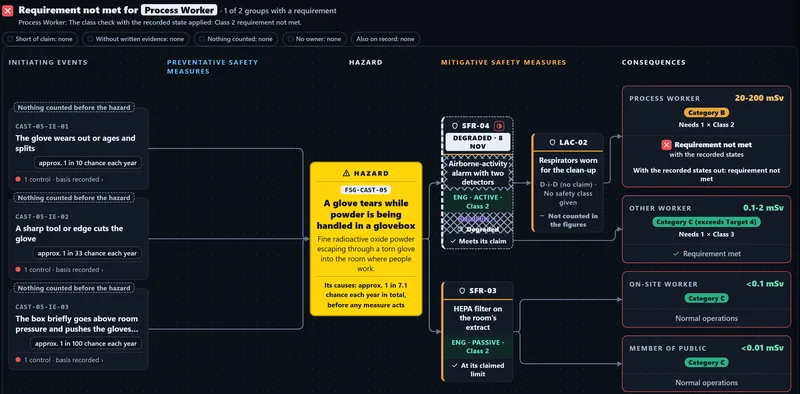
- See the state come in A person records a measure’s state, with the time and the reason; or an export from your asset management system proposes a component as out of service, and a person confirms it.
- See the effect on the fault’s route The bow-tie marks the affected measures as recorded, and the changes card lists each change with the figure before and after, for each route and each group.
- See the risk recalculated Your current risk, calculated from every measure recorded as failed, degraded or out for maintenance.
- See where you stand against the requirements Whether every group’s safety requirement is still met, and what it needs if not, so you can decide on interim measures rather than shut down by default.
Does your case show where you stand today?